Project record · Mexico · Bentonite calcination · In service since 2025
A bentonite calciner in Mexico has replaced twelve burners that are no longer manufactured, and the line is running. The original TJ050HAT-NF units were obsolete and the plant’s own atmospheric burner had already stopped. The three modules of four now carry Eacoon TJ0050 burners at 500,000 Btu/h with a 10:1 turndown, a DN65 gas train, a 4,500 m³/h variable-speed air supply, twelve local control boxes, one Siemens PLC cabinet and a GT-20 atmospheric burner as No. 13. On the HMI today, all thirteen report normal.
The Mexican calciner dries and calcines bentonite. Product leaves at around 350 °C and the calcination zone runs between 700 and 900 °C. Each burner sits in a 210 mm wall, so the flame tube cannot be lengthened to buy mixing time — whatever happens has to happen inside that depth.
The installed TJ050HAT-NF is out of production and spares are gone, but the harder requirement came from the plant’s temperature logic: the vapour outlet must hold a band, because too cold condenses in the downstream purification and too hot damages it. A PID loop trims dilution air through a servo valve to hold that band, and its low-temperature alarm must start a burner on its own. The replacement had to reproduce the heat input, the ignition sequence of twelve burners and a safety burner that runs independently of them.
The difficulty was not the 146.5 kW rating. The same device is a mechanical interface, an ignition programme and a temperature-safety element at once, and each of the three is specified by a different document.
The order covered the complete firing line rather than the burners alone: twelve TJ0050 burners with 1-inch gas and 2½-inch air connections, stainless flexible connectors, twelve ratio regulators with manual trim valves and solenoids, twelve air butterfly valves on Kromschröder IC 20-07W2T actuators, a DN65 main gas train with filter, volume corrector, overpressure shut-off, regulator and double safety solenoid, a DN65 air header, twelve burner control boxes, one 800 × 500 × 2000 mm PLC cabinet and the GT-20 safety burner with its own package.
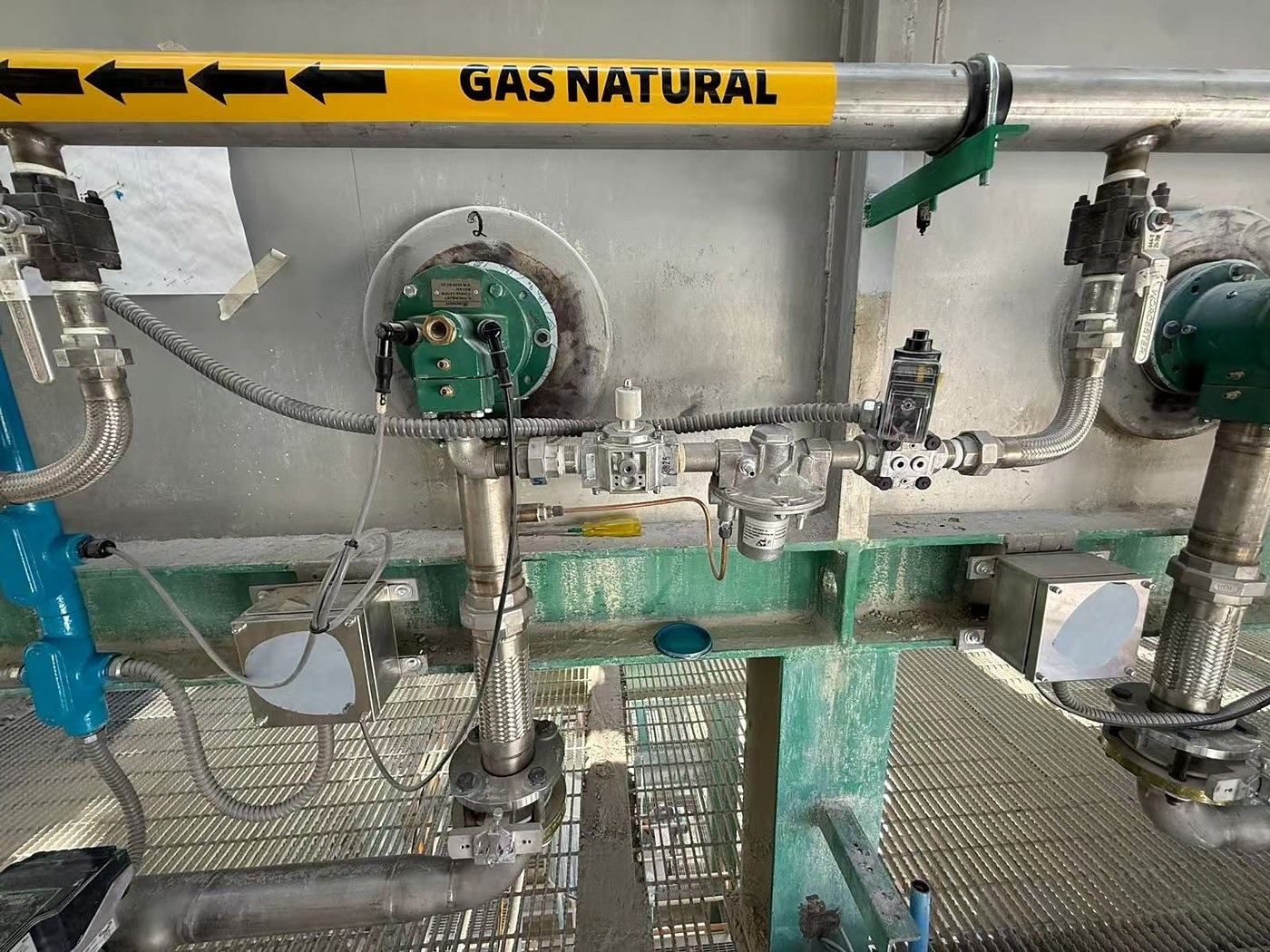
TJ0050 burner in service: gas train, ratio regulator, solenoid and flame scanner on the burner body. Photo: Eacoon.
Three decisions carried the project:
The system is running. The cabinet carries the six zone controllers and the 800 °C alarm, with reset, mute and stop-running on the door. The HMI puts the whole calciner on one screen: No. 1 to No. 13 with power status, the six zone temperatures and their average, main valve position, high and low gas pressure switches, and the combustion-air fan speed.
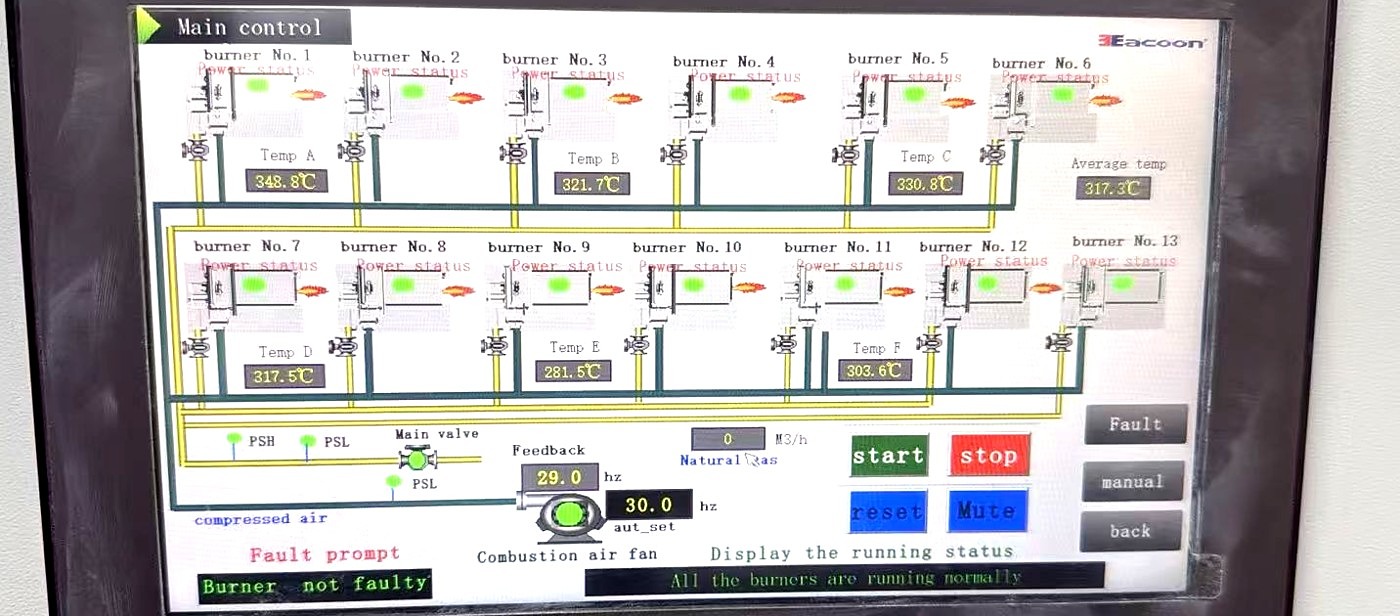
HMI main control screen: thirteen burners, six zone temperatures, main valve and fan speed on one page. Photo: Eacoon.
On the day it was photographed the six zones ran between roughly 280 and 350 °C against the 500 °C ceiling, with the fan at 29 Hz of its 30 Hz setpoint — well below the limit, where a calciner normally sits once the dilution-air loop is in charge. The status line reads that all burners run normally.
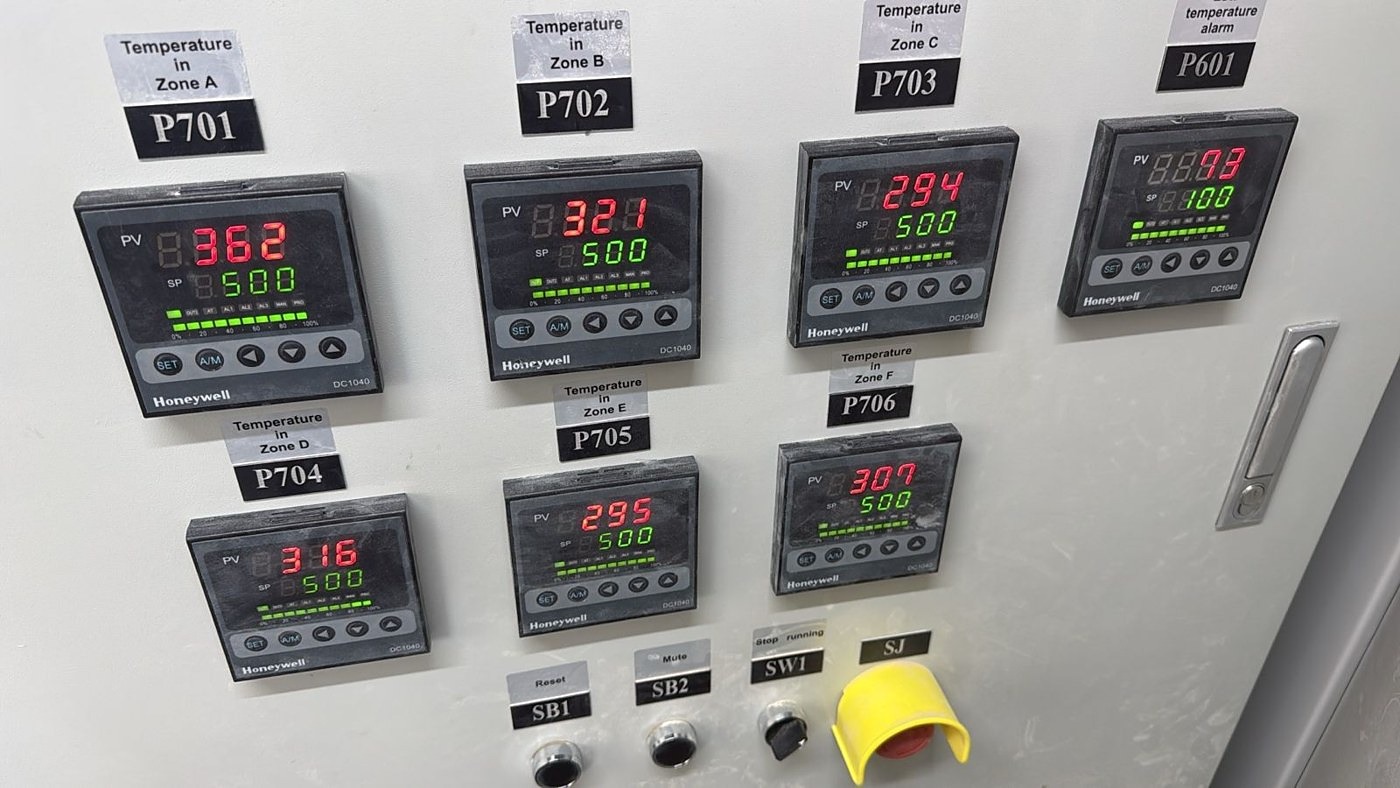
Six zone controllers, Zone A to F at 500 °C, with the 800 °C alarm instrument at the top right. Photo: Eacoon.
Eacoon has worked in industrial combustion for more than twenty years, with in-house R&D, core patents and participation in drafting industry group standards. Much of that work is replacement rather than new-build: matching equipment to an opening that already exists, a wall thickness that cannot change and a control philosophy the plant already runs.
The reference base covers metallurgy, heat treatment, non-ferrous melting, building materials and solid-waste incineration, in China and on export projects. Recent records include a 60-burner low-NOx retrofit in Lanzhou, a burner system for a waste-to-energy plant in Palembang and an emission retrofit for an oil refinery on hydrogen-rich tail gas.
Replacing a line that is out of production?
Send the original drawing, the mounting dimension, the rated duty and the wall thickness — we will come back with a drop-in configuration and an ignition and safety concept.
Tel +86 139 2888 4373 · Sales@eacoon-burner.com

